It gets reduced to a question of how much —
How much time do you have?
How much can you take on?
How much space is left?
But capacity is not just volume.
It’s not a container you fill.
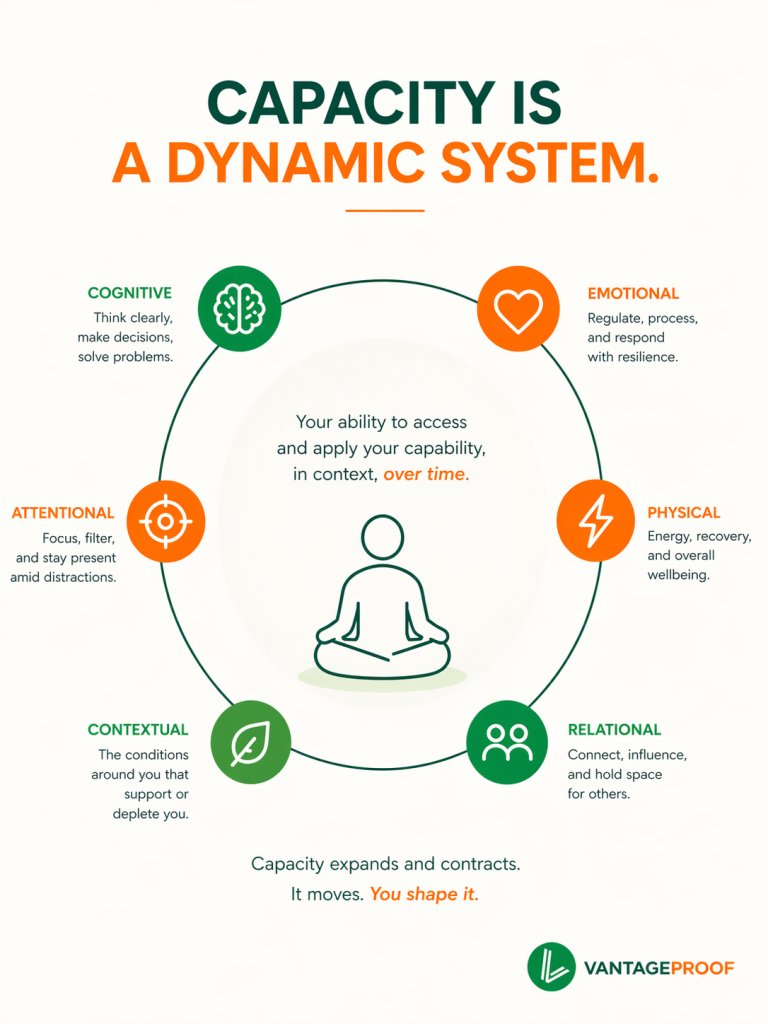
It’s a dynamic system.
When we treat capacity as static, we default to optimisation:
squeezing more in, stretching further, pushing limits.
When we understand capacity properly, we shift to regulation, alignment, and sustainability.
Because capacity is not just about having space.
It’s about what enables you to use that space effectively.
Capacity is Multi-Dimensional
What often looks like “lack of capacity” isn’t about time at all.
It’s the interaction of multiple components:
Cognitive capacity
Your ability to think clearly, prioritise, and make decisions — especially under pressure.
Emotional capacity
Your ability to process, regulate, and respond rather than react.
Physical capacity
Your energy, recovery, and overall wellbeing.
Attentional capacity
Your ability to focus without fragmentation in a world designed to distract you.
Relational capacity
Your ability to engage, influence, and hold space for others.
Contextual capacity
The conditions around you — systems, expectations, culture — that either support or deplete you.
Why It Feels So Unpredictable
Capacity is not fixed.
It moves.
It expands and contracts based on:
- Stress and recovery cycles
- Competing demands across life and work
- The quality of your environment
- The level of complexity you are navigating
This is why you can have “time available” and still feel completely stretched.
Or deliver exceptional work in a high-demand moment when everything is aligned.
Because capacity is not about hours.
It’s about access.
The Risk of Getting It Wrong
When capacity is misread as volume:
- Leaders overload high performers because they “can handle it”
- Individuals push through depletion, mistaking endurance for effectiveness
- Organisations design for output, not sustainability
And over time, this doesn’t increase performance.
It erodes it.
A More Useful Way to Think About Capacity
Capacity is better understood as:
Your ability to access and apply your capability, in context, over time
Which means the real question shifts from:
“Do we have capacity?”
to
“What is enabling or constraining capacity right now?”
What This Changes
For leaders, this becomes less about managing workload
and more about creating conditions:
- Where focus is protected
- Where energy is renewed, not just spent
- Where people can think, not just execute
- Where expectations align with what is realistically sustainable
Because when capacity is supported, performance follows.
Capacity isn’t something you fill.
It’s something you shape, protect, and grow.
And when you start seeing it that way,
you stop asking people to do more—
and start enabling them to be at their best, more often.
~ Vantage Proof Consulting.
April, 2026.